



























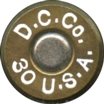
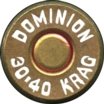
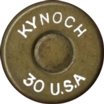
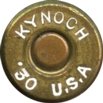
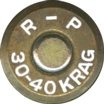
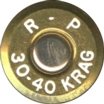
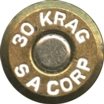
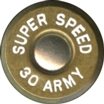
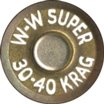





















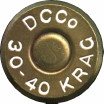
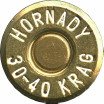
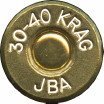
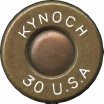
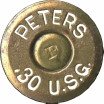
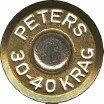

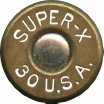








30-40 KRAG
| Calibre | 30-40 |
| In the cabinet | IMPERIAL MILITARY .30" UP TO .399" · 145 images |
Research notes
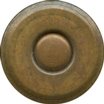
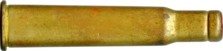
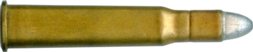
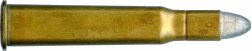
The development of smokeless powders during the late 1880’s and the subsequent move by the major European powers to smaller bore cartridges led the US Army Ordnance Office to start the search for a cartridge that can shoot a lighter weight bullet more accurately over longer distances. Various tests were done with different cases and bullets from the late 1880’s up to 1893, with the decision to adopt a rimmed design in June 1892. The bullet weight was also reduced to 220gr. and was manufactured from German Silver. This was also referred to as the “1st Model”
1st on the left is the "1st Model". During 1896 a knurled cannelure was added to the bullet.
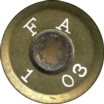
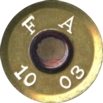
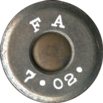
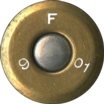
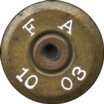
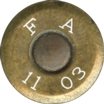
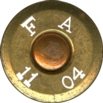
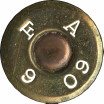
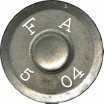
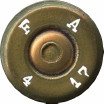
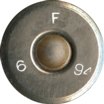
This F A 9 09 headstamp from September 1909 shown above was the last date to be made at Frankford Arsenal. See also HWS Vol. 1 p.75 that state that it might also have been used as a sub-caliber.
The loading above is the 220gr. Hudson-Thomas bullet as used by the American team at the 1907 Palma Match at Ottawa (Rockcliffe). There is however conflicting detail regarding this. Sources (box copies) state that the bullet was the pointed version, and others state it was a lighter 190gr. loading (Pitman) as well as a copy of a box shown in HWS Vol. 1 p77 showing the round nosed bullet above, and also state that various bullets may have been used.
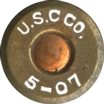
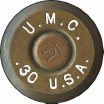
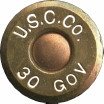
Various contract loads were ordered as can be seen below, particularly during the Spanish American War, 1898-99
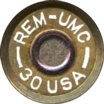
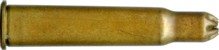
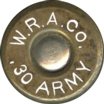
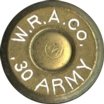
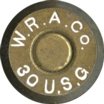
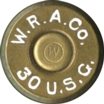
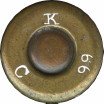
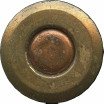
The first two specimen were contract loads by Kynoch, with the C meaning Cordite. In 1900 the Navy had adopted the Cal .30 Krag service rifle to replace the 6mm Lee. The Navy was forced to let a large contract to Remington for replenishing their stock of Ball ammunition. The primer cup was stamped with a ‘R’ for ‘Revised’ which had an increased charge.
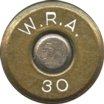
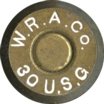
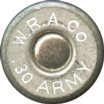
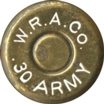
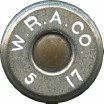
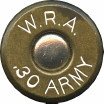
In October 1931 the Bureau of ordnance declared the Krag Model 1898 obsolete. Some of the late contract ammunition was released to civilian shooters through the National Board for the Promotion of Rifle Practice. The W.R.A. 30 cartridge with nickel alloy primer cup was one of these.
REDUCED RANGE CARTRIDGES
This was authorised in 1901 at the request from various field commands to be used in the place of ordinary service loads for target practice on limited ranges.
Due to the lack of accuracy of the first models, a new type was developed in late 1902. This cartridge was loaded with a 218gr. lead bullet with the same configuration as the service bullet. Later lots were identified by the blackened case.
BLANK CARTRIDGES
The first blank cartridges adopted were the ‘whole case’ or Model 1893. This type was produced until early 1896, when it was replaced by the paper bullet type. Development of the new type started in 1895 however, after complaint that, upon firing the old type, brass fragments were blown out and injuring personnel.
These whole case blank cartridges were also used in Gatling guns.
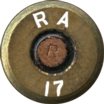
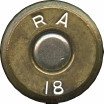
Various types of ‘bullets’ were tested but in late 1895 a hollow paper type bullet was perfected that was rolled into a cylinder and formed in a die. This blank cartridge was designated Cal. .30 Blank Cartridge, Model of 1896. The specimen with R A 18 headstamp was a WW1contract load by Remington
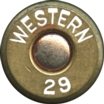
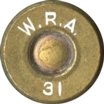
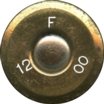
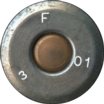
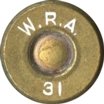
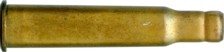
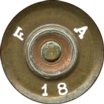
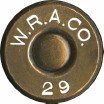
The W.R.A. 29 specimen is similar to the earlier M2 blank and the W.R.A. 31 specimen above is similar to the M3 blank and was loaded at Frankford Arsenal during the late 1920's and early 30's. It has a red wad at the case mouth.
DUMMY CARTRIDGES
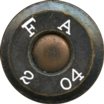
Although the manufacture of dummy rounds started as early as 1892, the first rounds were not adopted until 1895. The first model had no headstamp and 3 cannelures at the base near the rim. The first specimen below is an early Second Model, with no headstamp and inert primer. The second specimen is also a Second Model. Most of these were tinned cases, although post 1900 some had brass cases. The third and fourth specimen are the Third Model (1904 revision). From June 1905 onwards, cases were tinned for better identification.
GALLERY PRACTICE
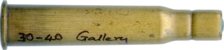
This was a very popular loading for indoor/short range target practice. Earlier loads had a solid turned brass body. In 1896 the load was changed to a round lead ball on a normal case with a seating cannelure on the neck to hold the bullet. In an effort to develop a more accurate gallery load, a loading was offered that had a flat based lead, semi round nose bullet.
GUARD LOAD
These were designed for guard and riot use and were adopted after 1900. During late 1902 a version was adopted that was a modification of the Gallery Load, but with 2 lead balls and the crimping cannelure moved down to the case neck. This was a short-lived project, and these loads were no longer authorised for manufacture after May 1904. After May 1904 the bullet was changed to a 156gr. lead bullet. The loading was let gain after WW1 under contract to Remington with nickel plated primer cups as can be seen below.
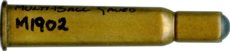
Various types were tested by the Ordnance Department during late 1900. One of these was the Scott Multi-ball that was invented by Robert W. Scott. There were two basic models, firstly a normal service case with shortened body and lengthened neck, over which a brass sleeve was fitted to bring the case back to a normal shape. The other version below had an extended neck and longer case.
shown at 150% scale
SUB-CALIBER
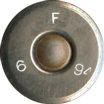
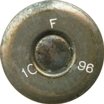
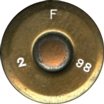
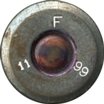
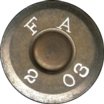
These cartridges were designed to be fired from sub caliber barrels mounted within or outside of the main artillery tube. The early versions had a reinforced primer in order to withstand the heavy strike of an artillery firing pin. In 1903 the primer was modified by fitting a metal protecting cap over the firing pin. The specimens below are the modified 1903 type where the metal cap was pierced to increase the sensitivity of the primer. This was done also so that the round could be fired by a normal rifle firing pin. First specimen on the left was loaded with the Cole "smooth" bullet (HWS 1 p.93).
In 1924 Frankford Arsenal developed the monel metal primer to replace the more complicated types. These primers were able to withstand the naval gun firing pins as well as being used in ordinary rifles. These were loaded in the beginning with the 220 gr. service bullet, however as supplies of these bullets became exhausted, the 172gr. National Match boat-tail bullets were used
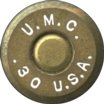
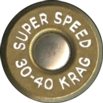
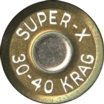
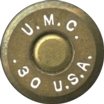
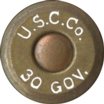
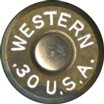
30-40 KRAG COMMERCIAL HEADSTAMPS
Sears Brand



